Standard architecture

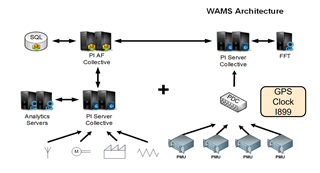
The recommended architecture for the PI System when collecting PMU data is different from our standards. This is because the high speed data coming from PMUs, FFT and other analysis can quickly fill up the archives at a much faster rate than a standard SCADA system. Usually, a WAMS PI System will be designed in such a way that it has enough disk space to hold a pre-defined amount (and minimum) of history for the PMU readings and will start cycling through the old archives as they fill up.

In other words, the SCADA data tags would be affected negatively if it was in the same PI Server as the PMU tags by having a limited amount of history available and potentially slow retrieval rates by client tools.

With that said, the overall architecture will have the standard PI System components plus potentially the separate servers for hosting PMU and FFT data as shown below:


arch.png.png

Ps: This is the reason for the PI C37.118 interface to require a CoE approval before a new download.

Parents
  • Bruno,


    Thanks for the post.  We should also mention that we've done some testing on the effects of compression on typical analytics use cases based on PMU (synchrophasor) data.  The tests results indicate that there's little impact on the analytics results even when compression is set to not write to disk 80-90% of the events coming in.   This means compression is very effective with this information.   Typically, though, we recommend at least one signal, usually frequency, is not compressed.  This has the advantage of making it possible to trace if all packets are being received, the drop out rate and if specific ones are missing.


    The PI Data Archive which works withe FFT interface also usually has a very small circular archive, something like 30 days.  Since FFT creates many more tags, and the data is not very valuable long term, this is an effective approach to manage resources.


    Thanks again Bruno!

Reply
  • Bruno,


    Thanks for the post.  We should also mention that we've done some testing on the effects of compression on typical analytics use cases based on PMU (synchrophasor) data.  The tests results indicate that there's little impact on the analytics results even when compression is set to not write to disk 80-90% of the events coming in.   This means compression is very effective with this information.   Typically, though, we recommend at least one signal, usually frequency, is not compressed.  This has the advantage of making it possible to trace if all packets are being received, the drop out rate and if specific ones are missing.


    The PI Data Archive which works withe FFT interface also usually has a very small circular archive, something like 30 days.  Since FFT creates many more tags, and the data is not very valuable long term, this is an effective approach to manage resources.


    Thanks again Bruno!

Children